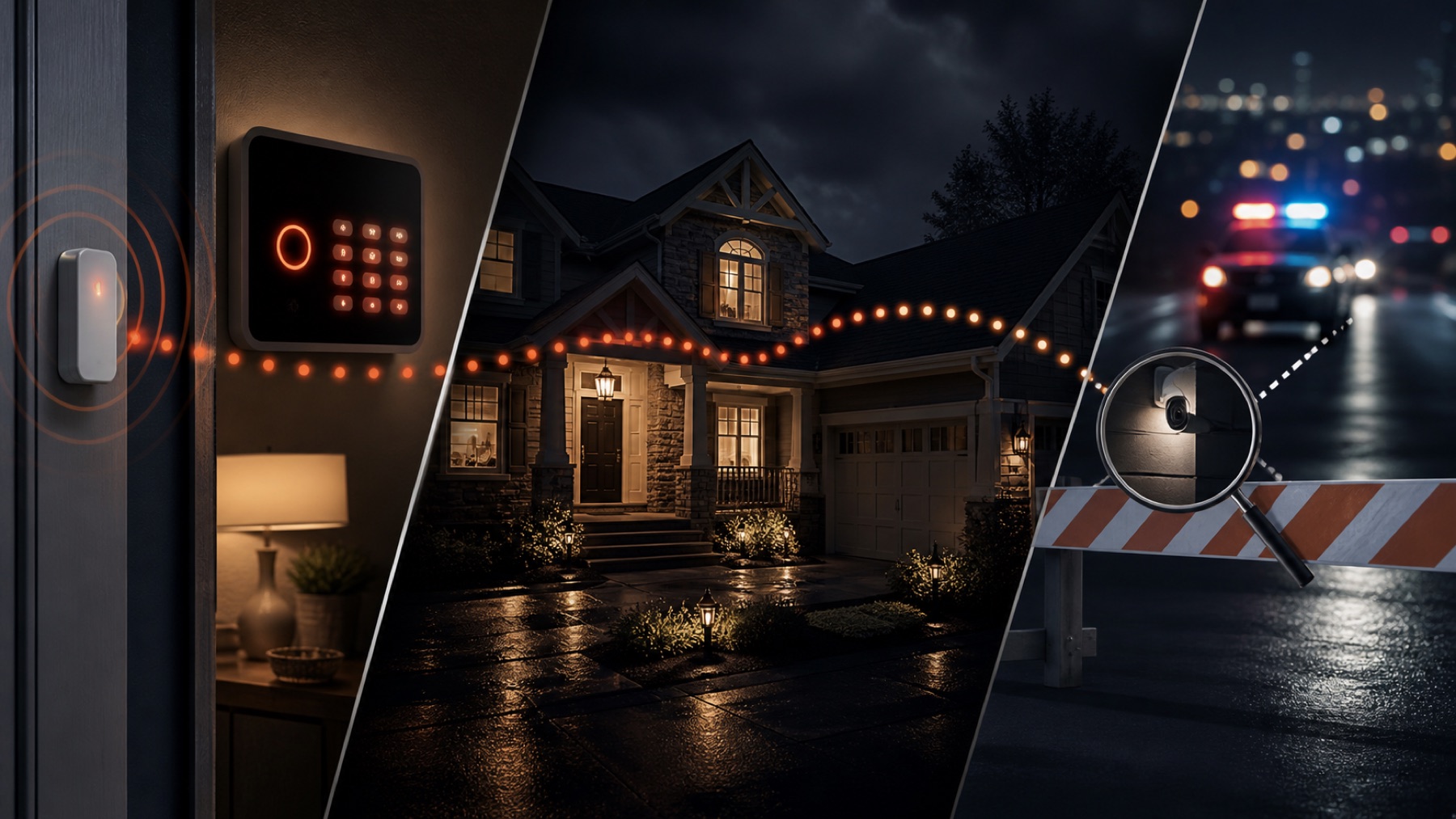
The Spill—in 30 seconds
- An intrusion sensor sends a signal; it does not itself order a police response.
- Some police departments require credible verification—such as video, audio, an eyewitness or a panic signal—before dispatching officers.
- Policies differ by city, alarm type and permit status. Ask the monitoring company what happens at your exact address.
In this story
Short answerVerified responseWhat monitoring doesQuestions to askSystem designFAQSourcesHome security advertising compresses a chain of events into one comforting image: the sensor trips, professionals react, police arrive.
The real chain has more links. A device detects something. A panel communicates. A monitoring center receives and classifies the event. Operators or automated systems attempt verification. Only then may a request reach a public-safety answering point—and the police department still decides whether and when to dispatch.
What “verified response” means
A verified-response policy asks for evidence beyond a lone intrusion sensor before police are sent. Accepted evidence varies, but can include live or recorded video, two-way audio, an eyewitness, a guard at the property, multiple independent sensor activations, or a panic or duress signal.
The policy exists because intrusion alarms generate large numbers of false calls. In a September 2024 letter to alarm companies, Seattle’s interim police chief reported roughly 13,000 residential and commercial burglary-alarm calls from alarm companies in 2023; less than 4% were confirmed to involve a crime that led to a report or arrest. Police agencies want officers available for confirmed crimes and emergencies. The security industry argues that strict nonresponse can leave legitimate burglaries waiting for proof. Both concerns are real, which is why local rules and alarm-validation standards keep evolving.
Seattle’s policy, effective October 1, 2024, required supporting evidence for dispatch to professionally monitored intrusion alarms, according to the September 13, 2024 police-chief letter published by The Monitoring Association and contemporaneous local reporting. Las Vegas Metropolitan Police currently includes “Why didn’t a police unit respond when my burglar alarm was tripped?” in its communications FAQ—an important signal that dispatch is not automatic even in a major monitored-alarm market.
Jurisdiction matters
There is no single national burglar-alarm dispatch rule. The city, county, alarm permit, signal type, false-alarm history and information supplied by the monitoring center can all change the response.
What professional monitoring actually buys
Professional monitoring can provide continuous signal receipt, contact attempts, escalation procedures, records and communication with emergency services. That is valuable. It is not a contractual power to command police resources.
When an intrusion alarm arrives, a monitoring center may first use an abort delay, call the premises, contact account holders, request camera clips, open two-way audio, or check whether a second sensor confirms movement through the property. The order depends on the system, plan, local ordinance and signal.
Modern standards increasingly communicate the credibility of an alarm rather than treating every signal alike. The Monitoring Association’s ANSI/TMA-AVS-01 (2024) Alarm Validation Scoring standard defines Alarm Levels 0, meaning no call for service, through 4, a confirmed threat to life. The goal is to help public safety distinguish an unverified single sensor from an event supported by stronger evidence.
None of this means “cameras always equal faster police.” A camera must cover the right area, remain online, produce usable images and be integrated into a monitoring workflow that can send verification. A doorbell recording stored only on the homeowner’s phone may not help an operator in time.
Seven questions to ask before buying monitoring
- What is the current police alarm-response policy at my address? Ask for the jurisdiction, not a national answer.
- Which signals require verification? Separate burglary, panic, duress, fire, carbon monoxide and medical events.
- How do you verify? Video, audio, multiple sensors, phone calls, text, app prompts or a guard?
- Who can access camera clips during an alarm? Confirm consent, retention and privacy settings.
- What happens if internet or power fails? Ask about cellular backup, battery duration and supervision.
- Do I need an alarm permit? Missing permits or repeated false alarms can cause fees or nonresponse.
- What is guaranteed? Monitoring response times, police arrival and loss prevention are different promises.
Design the system for evidence, not just noise
A siren can deter and alert occupants, but verification requires context. Put door and window sensors at likely entry points. Use interior motion in a sequence that can confirm travel through the house. Place cameras where they can see faces and entry paths without intruding on private spaces. Test communication paths and keep the contact list current.
If your system supports a duress code, ask the monitoring provider how it works and teach household members the agreed procedure. Do not trigger panic or duress signals as a test. Coordinate testing with the monitoring company so an exercise does not become a false emergency call.
Finally, read the monitoring agreement. Look for equipment ownership, contract term, cancellation, price increases, moving, video access, permit responsibility and limits of liability. A familiar brand can still offer multiple plans with materially different verification capabilities. For another look at automated decisions and consumer records, see our life-insurance underwriting guide.
Frequently asked questions
Do police always respond to monitored home alarms?
No. Response depends on local policy, signal type, verification, permit status, available officers and other circumstances. Monitoring is not a guarantee of dispatch or arrival time.
What counts as a verified burglar alarm?
It varies. Common forms include video or audio evidence, an eyewitness, a guard, a panic signal or multiple independent activations that increase confidence.
Will a security camera guarantee police response?
No. The image must be available, useful and integrated into the verification process, and the local agency retains dispatch authority.
Are fire and medical alarms treated the same as burglary alarms?
Often not. Emergency and panic signals may have separate protocols. Ask the monitoring provider and local authority about each signal type.
The product is not “police on demand.” The product is detection, evidence and a professionally managed escalation path.
Sources
- Las Vegas Metropolitan Police Department, Communications Frequently Asked Questions, accessed September 7, 2026.
- Seattle Police Department, September 13, 2024 alarm-response letter, published by The Monitoring Association.
- FOX 13 Seattle, Seattle police will require video or eyewitness evidence for burglary alarm calls, September 2024.
- Security Industry Association, Some Cities Are Requiring Alarm Verification for Response, October 7, 2024.
- The Monitoring Association, ANSI/TMA-AVS-01 Alarm Validation Scoring Standard.